Wednesday, September 22, 2021

6th Grade : SIMPLE PAST REGULAR and IRREGULAR VERBS

 http://espinheiraenglish3.blogspot.com/2021/03/simple-past-regular-irregular-verbs.html

Forming Past Simple Tense :

https://espinheiraenglish3.blogspot.com/2021/04/irregular-verbs-forming-past-simple.html



Past simple – regular verbs


The past simple is the most common way of talking about past events or states which have finished. It is often used with past time references (e.g. yesterday, two years ago).

Please explain past events or states!

A past event could be one thing that happened in the past, or a repeated thing.

I stopped at a zebra crossing.
We carried on with the test.
We played tennis every day in August.

A state is a situation without an action happening.

We stayed at my grandparents' house last summer.

How do you form the past simple?

Regular past simple forms are formed by adding -ed to the infinitive of the verb.

start → started
kill → killed
jump → jumped

That seems easy!  

Yes, but there are some spelling rules. If a verb ends in -e, you add -d.

agree → agreed
like 
→ liked
escape 
→ escaped

If a verb ends in a vowel and a consonant, the consonant is usually doubled before -ed.

stop → stopped
plan 
→ planned

If a verb ends in consonant and -y, you take off the y and add -ied.

try → tried
carry 
→ carried        

But if the word ends in a vowel and -y, you add -ed.

play → played
enjoy 
→ enjoyed

OK, not quite so easy! But the past simple form doesn't change at all for I, you, he, she, we and they, does it?

No, the form doesn't change. See, it is easy!

What about the pronunciation of the -ed ending?

There are three kinds of pronunciation: /d/, /t/ and /ɪd/. Look at the table below.

/d//t//ɪd/
arrivedaskedwanted
failedcrosseddecided
agreedstoppedstarted

Aaagh! How do I know how to pronounce each one?

Good question. Well, really all you need to know is that /d/ is easier to say after arrive, and /t/ is easier to say after ask. For /ɪd/, the infinitive ends in a /d/ or a /t/ sound already so you must add an extra syllable for these verbs.

All right, that makes sense, but how do you form questions and negatives?

With the verb did (do in the past) + the infinitive.

Did you pass?
You didn't fail, did you?
Yes, I did. / No, I didn't.

Right, thanks, I've got it now!

Good. But you also need to learn the irregular past simple forms.

You mean there are verbs that don't end in -ed in the past?

Yes, they don't all end in -ed. Have a look at the past simple irregular verbs too.

HideCheck your grammar: true or false - past simple regular verbs

Check your grammar: gap fill - past simple regular verbs
https://learnenglishteens.britishcouncil.org/grammar/beginner-grammar/past-simple-regular-verbs

Monday, September 20, 2021

5th grade : HOW OFTEN DO YOU ... ?

HOW OFTEN DO YOU ... ? HOW OFTEN DOES YOUR FRIEND ... ?

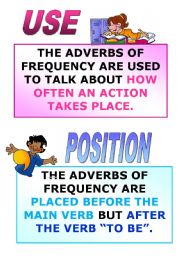
We use some adverbs to describe how frequently we do an activity. These are called adverbs of frequency .


FrequencyAdverb of FrequencyExample Sentence
100%always I always go to bed before 11pm.
90%usuallyI usually have cereal for breakfast.
80%normally / generallyI normally go to the gym.
70%often* / frequentlyI often surf the internet.
50%sometimesI sometimes forget my wife's birthday.
30%occasionallyI occasionally eat junk food.
10%seldomI seldom read the newspaper.
5%hardly ever / rarelyI hardly ever drink alcohol.
0%never I never swim in the sea.
* Some people pronounce the 'T' in often but many others do not.

The Position of the Adverb in a Sentence

An adverb of frequency goes before a main verb (except with To Be).
Subject + adverb + main verb
I always remember to do my homework.
He normally gets good marks in exams.

An adverb of frequency goes after the verb To Be.
Subject + to be + adverb
They are never pleased to see me.
She isn't usually bad tempered.

We can also use the following adverbs at the beginning of a sentence:
Usually, normally, often, frequently, sometimes, occasionally
  • Occasionally, I like to eat Thai food.
BUT we cannot use the following at the beginning of a sentence:
Always, seldom, rarely, hardly, ever, never.

We use hardly ever and never with positive, not negative verbs:
  • She hardly ever comes to my parties.
  • They never say 'thank you ^.


ONLINE ACTIVITIES :


How Often Do You Use Electronic Gadgets:

  • calculator

  • tablet

  • MP3 player

  • headphones

  • video games console

  • webcam

  • stopwatch

  • pen drive

  • satnav
  • charger


How frecuently  do your classmates do these activities on a computer?


Sunday, June 6, 2021

HOW OFTEN DO YOU ... ? HOW OFTEN DOES YOUR FRIEND ... ?

We use some adverbs to describe how frequently we do an activity.These are called adverbs of frequency 

FrequencyAdverb of FrequencyExample Sentence
100%always I always go to bed before 11pm.
90%usuallyI usually have cereal for breakfast.
80%normally / generallyI normally go to the gym.
70%often* / frequentlyI often surf the internet.
50%sometimesI sometimes forget my wife's birthday.
30%occasionallyI occasionally eat junk food.
10%seldomI seldom read the newspaper.
5%hardly ever / rarelyI hardly ever drink alcohol.
0%never I never swim in the sea.
* Some people pronounce the 'T' in often but many others do not.

The Position of the Adverb in a Sentence

An adverb of frequency goes before a main verb (except with To Be).
Subject + adverb + main verb
I always remember to do my homework.
He normally gets good marks in exams.

An adverb of frequency goes after the verb To Be.
Subject + to be + adverb
They are never pleased to see me.
She isn't usually bad tempered.

We can also use the following adverbs at the beginning of a sentence:
Usually, normally, often, frequently, sometimes, occasionally
  • Occasionally, I like to eat Thai food.
BUT we cannot use the following at the beginning of a sentence:
Always, seldom, rarely, hardly, ever, never.

We use hardly ever and never with positive, not negative verbs:
  • She hardly ever comes to my parties.
  • They never say 'thank you'.


How Often Do You Use Electronic Gadgets:

  • calculator

  • tablet

  • MP3 player

  • headphones

  • video games console

  • webcam

  • stopwatch

  • pen drive

  • satnav
  • charger

How frecuently  do your classmates do these activities on a computer?


Wednesday, May 12, 2021

IRREGULAR VERBS TEST

 IRREGULAR VERBS TEST : FRIDAY , 21st MAY 2021


SPANISH


INFINITIVE


PAST SIMPLE


PAST  PARTICIPLE


GANARLE( a alguien)


beat


beat


beaten


SOÑAR


dream


dreamt


dreamt


PERDONAR


forgive


forgave


forgiven


ESCONDER


hide


hid


hid


LLEGAR A SER


become


became


become

 DOLER,

HACER DAÑO


hurt


hurt


hurt


SUJETAR


hold


held


held


PRESTAR


lend


lent


lent


PAGAR


pay


paid


paid


CERRAR


shut


shut


shut


LISTENING :

https://elllo.org/english/levels/index.htm